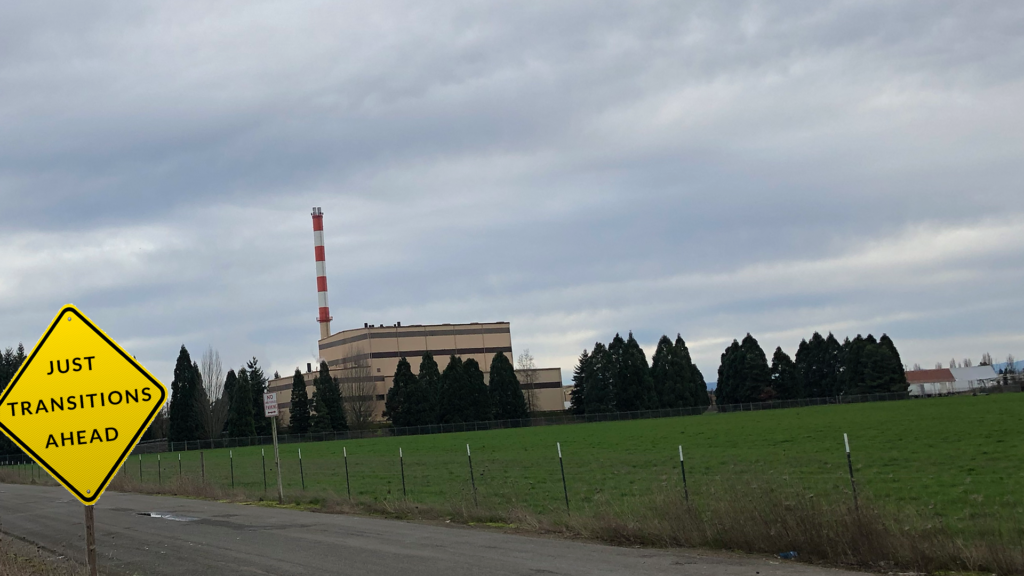
Covanta-Marion/Reworld Incinerator in Brooks, Oregon
Anti-Incinerator Advocacy
Delayed maintenance, a fire, and turbine failure caused incinerator closure
Turbine failure caused Reworld closure. Will incinerator reopen?
by Tracy Loew March 23, 2026
“The Reworld Marion garbage incinerator in Brooks closed down in early 2025 because of a turbine failure, documents the company submitted to Marion County state.”
Plan to sell incinerator fails
Reworld Marion garbage incinerator sale to Houston company fails
by Tracy Loew Jan 7, 2026
“A potential deal to sell the shuttered Reworld Marion municipal waste incinerator to Houston-based Peaker Energy has fallen through.
On Jan. 5, Reworld notified the Oregon Department of Environmental Quality that it was no longer in negotiations with the company and would move to terminate the facility’s air quality permit.”
New medical waste facility planned, unclear when operation will start or how much medical waste will be processed
New medical waste facility approved to operate in Northgate after neighborhood opposition
by Madeleine Moore April 9, 2025
“The waste facility ‘would negatively impact nearby residential areas,’ and is ‘incompatible with surrounding businesses and senior center,’ Tracey-Gaynair said in a January email to the city.”
The City of Salem does not control where city waste goes, could that change?
Marion County opposes bill giving local control over solid waste
by Tracy Loew April 4, 2025
“When the Reworld garbage incinerator in Brooks shut down Dec. 31, Marion County didn’t just need to find a different place to send residents’ garbage.
It also lost a substantial source of income.”
Is the incinerator permanently closed?
Is Marian County trying to buy the Reworld Marion Garbage Incinerator in Brooks?
by Tracy Loew Jan 18, 2025
“Marion County, which issued $56 million in bonds to build the incinerator, left a partnership with the operator in July 2021. The Reworld Marion garbage incinerator in Brooks may not permanently close.”
Brooks garbage incinerator fined for exceeding emissions limits
Salem Reporter July 30, 2024
The Oregon Department of Environmental Quality (DEQ) fined the Reworld Marion Inc. garbage incinerator in Brooks $22,800 in June 2024 for exceeding air pollution limits. The 38-year-old facility, which burns most of Marion County’s waste, violated permits between 2022 and 2024 for emissions of carbon monoxide, sulfur dioxide, and opacity.
Brooks incinerator to end waste services. What that could mean for garbage rates
by Tracy Loew Oct 11, 2024
“Reworld Marion will stop taking waste from Marion County at the end of the year, the company has told county commissioners.
The 38-year-old municipal waste incinerator, formerly called Covanta Marion, burns about half of the garbage in the county.”
Senate Bill 488 passes
Bill to further regulate Oregon’s last remaining incinerator signed into law
by Environment Oregon Aug 7, 2023
“On Friday Governor Kotek signed a bill to cap and monitor toxic emissions from Oregon’s last remaining incinerator. A bill to require Covanta Marion, Oregon’s last remaining municipal waste incinerator, to do continuous monitoring of its most toxic and hazardous emissions and cap the amount of medical waste it can burn, was signed into law by Governor Kotek on Friday.
As has been well documented, the plastic waste that is being burned at Covanta causes high levels of cancer-causing and highly toxic pollutants like dioxins, which can cause skin, blood, liver and reproductive problems. It also releases heavy metals and mercury, a neurotoxin that impairs brain function. Exposure to these emissions are dangerous for the people who live and work in proximity to the facility, and for our air, water and climate.
The burning of medical waste is of particular concern because it is much more toxic than municipal waste, containing a high percentage of heavy metals, plastics, and polyvinyl chloride. According to the latest DEQ records, Covanta burned over 16,300 tons of medical waste alone in 2022. Senate Bill 488 will give the state of Oregon a better understanding of the highly hazardous pollutants that result from the burning of these plastics, industrial waste and other materials and caps how much can be burned every year.”
Oregon’s legislature passes nation’s strictest incinerator monitoring bill
by Tracy Loew June 22, 2023
“Senate Bill 488 requires Covanta Marion to continuously monitor carbon monoxide, sulfur dioxide, nitrogen oxides, opacity, PCBs, dioxins/furans, cadmium, lead, mercury, arsenic, total chromium, manganese, nickel, selenium and zinc.”
Senate bill addresses problem of poorly regulated medical waste incineration in Oregon
by Mike Ewald March 17, 2023
Did you know Oregon is home to the only place in the western half of the United States that still imports and burns medical waste?
That place is in Marion County, home of Covanta’s trash incinerator, the only plant burning trash or medical waste in the state. It burns around 14,000 tons of medical waste each year, mostly from out-of-state, turning it into dangerous air pollution and toxic ash that is then buried in Oregon’s landfills.
In 1988, there were over 6,200 medical waste incinerators in the U.S. Today, about 30 remain. Hospitals did not fail for lack of waste handling. The industry moved to clean, non-burn alternatives, primarily autoclaving which steam sterilizes biological hazards without creating more dangerous chemical hazards by burning.
Why is Covanta burning medical waste in a trash incinerator? Greed. Covanta rakes in about $500 more per ton for medical waste than it does for trash. Covanta Marion is among the nation’s smallest and oldest incinerators, so it’s not very profitable unless it burns lucrative (but more dangerous) waste streams like medical waste and liquid industrial wastes.
The problem is that Covanta isn’t playing fair. It is exploiting a federal loophole that allows it to follow far weaker emissions standards than if it were regulated as a large new medical waste incinerator. With the amount of medical waste Covanta burns, it’s more than six times over the limit of what qualifies as a “large” medical waste incinerator.
Standards for new medical waste incinerators are far stricter than the standards for how much pollution a trash incinerator can put into the air. Because of this loophole for burning medical waste at a trash incinerator, Covanta gets away with spewing more cadmium, lead, mercury, carbon monoxide, nitrogen oxides, sulfur dioxide and hydrochloric acid into the air than would be legal if it were regulated as a medical waste incinerator.
Covanta’s competitors in the eastern half of the country that burn only medical waste have to comply with this stricter standard. While Covanta burns more medical waste than most of its competitors, its less-regulated cash cow gets to profit at the expense of public health for Oregonians. It’s not fair.
Democratic state Sen. Deb Patterson of Salem has introduced Senate Bill 488 to address this problem of poorly regulated medical waste burning in Oregon. The bill would require that if an incinerator is burning enough medical waste to qualify as a medium- or large-scale medical waste incinerator, the more protective federal regulations for burning medical waste should apply.
Of course, Covanta will claim that the sky will fall if you make it play by the rules that others must follow. Executives will say their plant will shut down. They’ll say that Oregon hospitals will have nowhere to handle their waste – also untrue.
They’ve even claimed that all but a handful of states require medical waste to be incinerated. In fact, not a single state has such a requirement to burn medical waste in general. However, Oregon requires burning of pathological waste (body parts), which represents just about 1% of hospital waste. Even if Oregon keeps its requirement to burn pathological waste instead of allowing safer options (as nearly all states do), there’s no need to burn standard red-bag medical waste, or anything imported from other states.
Senate Bill 488 would make Covanta choose: Follow the stricter modern standards for new medical waste incinerators, or stick to burning just the in-state pathological waste that state law requires to be burned, which would be little enough that they won’t be subject to the stricter requirements.
Several state and local environmental and public health organizations are uncomfortable with Oregon hosting a trash incineration facility – and rightly so. Covanta Marion, the state’s only remaining trash incinerator, is an old, technologically outdated facility that continues to burn upwards of 180,000 tons of waste each year. Like all waste incinerators, Covanta Marion pollutes the soil, water and air with lead, mercury, dioxins, and dozens of other toxic chemicals, harming Oregonians with everything from cancer to learning disabilities.
The Legislature would be wise to enact Senate Bill 488. It’s an important piece of health policy that would ensure the first edict of medical ethics: “first, do no harm.”
Oregon Legislature debates medical waste burning at Covanta incinerator in Marion County
by Tracy Loew March 16, 2023
“The Brooks facility now is the fourth-largest medical waste incinerator in the country. For years, Marion County residents have debated whether the increasing amount of out-of-state medical waste burned at Covanta Marion, the municipal waste incinerator in Brooks, is safe.”
Oregon may tighten Covanta waste incinerator emissions, require health study
by Tracy Loew Jan 22, 2023
“Covanta is taking advantage of a loophole to make Oregon a dumping ground for the toxic pollution other states don’t want,” said Sen. Deb Patterson.
Oregon’s only municipal waste incinerator may soon be subject to more study and stricter regulations.”
Moss Testing Around Reworld Marion Waste Incinerator
US Forest Service moss study links heavy metal pollution to Brooks incinerator
by Tracy Loew Nov 13, 2024
“A new study of pollutants in moss near the Reworld Marion garbage incinerator north of Salem in Brooks shows higher concentrations in samples taken closer to the facility and identified ‘signature’ rare earth element concentrations linked with burning medical waste.”
Scientific Report on Moss Testing Around Reworld Marion Waste Incinerator (2024)
“Putting biomonitors to work: native moss as a screening tool for solid waste incineration”
by Sarah Jovan, Eleonore Jacobson, Jason M. Unrine, Nasser Jalili-Jahani & Bruce McCune (Nov 2024) in Environmental Monitoring and Assessment vol. 196
“Abstract: Solid waste incineration (SWI) can release numerous air pollutants although the geographic reach of emissions is not routinely monitored. While many studies use moss and lichens for biomonitoring trace elements, including around SWIs, few investigate the complex, multi-element footprint expected from SWI emissions. This study develops using native moss as a screening tool for SWI while also informing community concerns about an aging incinerator in rural Oregon, USA. Trained community volunteers helped collect 36 composite samples of epiphytic moss (Orthotrichum s.l.) along a 32-km transect from the SWI. We used ICP-MS to measure 40 elements in moss, including 14 rare earth elements (REEs) previously unexplored for SWI. We compared the elemental signatures of samples with an emissions profile for SWI and modeled relationships between element concentrations and distance from the facility using nonparametric regression. The chemical signatures in moss pointed to SWI as a source, potentially through both stack and fugitive dust emissions. The strongest models described farther-dispersing elements, including mercury and cadmium (xR2 = 0.65 and 0.62, respectively), and suggested most deposition occurs within 5 to 10 km of the facility. Elements often associated with soil and dust, like arsenic and chromium, exhibited localized peaks within 0.2 km of the incinerator (xR2 = 0.14–0.3). Three novel elements—cesium and REEs europium and gadolinium—also showed promise as atmospheric tracers for SWI. Gadolinium, a contrast reagent for MRIs, could reflect medical waste incineration by the facility. We include additional analysis and discussion to help stakeholders use results effectively.”
County considers using toxic incinerator ash as cover for landfill
MARION COUNTY BOARD OF COMMISSIONERS: Board Session Agenda Review Form Sept 21, 2022
“Consider approval of a Sole Source procurement for use of incinerator ash for alternate daily cover (ADC)
at the Coffin Butte Landfill (managed by Valley Landfills, Inc).”
Portions of it say:
1) Marion County proposes to send 65,000 tons of incinerator ash to Coffin Butte Landfill per year. (See last sentence on page 1 of County memorandum dated July 9, 2012 in Exhibit A.)
2) The TestAmerica document from 2010 in Exhibit C says the incinerator ash contains more than 1000 parts per million of lead, plus lesser amounts of arsenic, cadmium, etc. These are unhealthy levels to breathe if they become airborne.
Marion County plan to study incinerator ash, soil, and leachate 2015
More waste incineration resources: https://energyjustice.net/incineration/
In the 2023 Oregon legislative session Senate Bill 488 requires municipal solid waste incinerators to implement continuous emissions monitoring for hazardous pollutants and caps the incineration of medical/infectious waste. Signed into law on August 4, 2023, this legislation created some of the nation’s strictest monitoring rules.
Key Provisions of SB 488 (2023):
- Continuous Monitoring: Operators must develop plans for continuous monitoring or sampling of specified emissions for 12 consecutive months, making data available to the Oregon Department of Environmental Quality (DEQ) and the public.
- Pollutants Covered: Mandated monitoring includes carbon monoxide, PCB, dioxins/furans, cadmium, lead, mercury, arsenic, and other heavy metals.
- Medical Waste Cap: Municipal solid waste incinerators are prohibited from combusting more than 18,000 tons of hospital, medical, or infectious waste in a single calendar year.
- Implementation: The DEQ was required to submit a progress report on implementation by September 15, 2024.
- Impact: The bill was largely aimed at the Covanta Marion incinerator in Brooks, which processes waste for several Oregon counties, to improve air quality for surrounding communities.
Testimony in support of SB 488
Senate Bill 488 passes
Oregon’s legislature passes nation’s strictest incinerator monitoring bill
by Tracy Loew June 22, 2023
“Senate Bill 488 requires Covanta Marion to continuously monitor carbon monoxide, sulfur dioxide, nitrogen oxides, opacity, PCBs, dioxins/furans, cadmium, lead, mercury, arsenic, total chromium, manganese, nickel, selenium and zinc.”

In the 2020 Oregon legislative session, House Bill 4049 was introduced to grant renewable energy credits to the Covanta Marion waste incinerator, but it failed to pass following a coordinated campaign by environmental groups and local residents.
Key Details Regarding HB 4049 (2020):
- Purpose: The bill would have allowed the Covanta Marion waste-to-energy facility in Brooks, Oregon, to receive renewable energy certificates, classifying the incineration of trash as “clean energy.”
- Opposition: A coalition of environmental justice and climate groups argued against the bill, calling it “greenwashing” and noting it would undermine established clean energy policies.
- Status: While tracked as a key bill in early 2020, it did not pass during the brief 2020 legislative session.
Testimony against HB 4049
Oregon bill to give Covanta incinerator renewable energy credits put on hold
by Tracy Loew Feb 13, 2020
Marion County garbage rates will double without legislative fix, Covanta claims
by Tracy Loew May 13, 2019
“Garbage disposal costs will more than double in Marion County if the Oregon Legislature doesn’t pass a bill designating trash incineration as renewable energy, representatives from Covanta Marion, the state’s only trash incinerator, warned Monday.”
Public raises concerns about Covanta incinerator’s impact on the environment
by Tracy Loew Oct 12, 2021
Marion County garbage rates will double without legislative fix, Covanta claims
by Tracy Loew May 13, 2019
“Garbage disposal costs will more than double in Marion County if the Oregon Legislature doesn’t pass a bill designating trash incineration as renewable energy, representatives from Covanta Marion, the state’s only trash incinerator, warned Monday.”
Salem residents deserve truth about the costs, pollution of incinerator
by Susann Kaltwasser Nov 13, 2018
Medical waste could mean cash for Marion County
by Tracy Loew June 24, 2016
“The Brooks garbage incinerator, just north of Salem, may soon take more out-of-state medical waste – as much as 50 million pounds more per year.
Marion County Commissioners will vote on the proposal at their June 29 meeting.
The county’s revenue from the 30-year-old incinerator has been dropping, and medical waste is lucrative.”
Medical Waste Incineration: The Hidden Agenda Part 1
by Ellen Twist 1999
“The Ogden Martin Garbage incinerator, located five miles north of Salem, has been controversial from its inception a dozen years ago. Many citizens testified against it in 1989, expressing concerns ranging from cost of the burner to the environmental impact of incinerating raw municipal waste.
To disarm its critics, the Marion County Board of Commissioners created the Solid Waste Management Advisory Council to “represent the overall public interest and preserve trust by acting in an ethical and responsible manner.”
Contrary to its mission, selected meetings are held away from public view, Council records are kept from public inspection, votes on important issues are taken without notice, and Advisory Council vacancies go unfilled for years. There has been an extraordinary incidence of member turnover and absenteeism. Astoundingly, the County Commissioners even appointed a Chairperson who had not attended a meeting in years. Strategic waste management decisions are made without notice to the Council. In short, this is politics and policy-making at its worst.”
Medical Waste Incineration: The Hidden Agenda, Part 2
by Ellen Twist 1999
“That’s why it is so very important to slow and eventually prevent the creation of dioxin locally. It is well-documented that incineration is the major cause of dioxin being created and released into the environment. Because there is a high concentration of plastic and PVC in medical waste, incineration of medical wastes is the number one method of transmitting dioxin into the environment.
The county’s garbage incinerator in Brooks burned 880 tons of medical waste in 1996, averaging about 75 tons a month. 278 tons of the 1996 total was from Marion County; the remaining 500 tons of medical waste came from areas where folks are apparently smart enough not to soil their nest, so to speak.”
The Oregon Environmental Quality Commission certified $19.7 million in tax credits for the incinerator
County will net millions from tax credit sale
by Mary Parkinson Dec 20, 1986
Incinerator owners promise ash is safe
Burner ash proves safe, owner says
by Dan Bender Nov 28. 1986
Incinerator Timeline
More on anti-incinerator advocacy from Beyond Toxics
More on incinerator closures from Energy Justice Network